
 WALL STREET JOURNAL – Dating apps are asking users to pay more for features and access to matches as a way to counter slowing growth. WSJ's Heard on the Street columnist Laura Forman talks about the pressure on Match Group.
Category: Reporters – Laura Forman
Online Dating Is Great for Investors, Complicated for Customers
 WALL STREET JOURNAL – Together, Wall Street expects Match and Bumble to generate ~$4B this year. Online dating provides more specific results from a wider net. Tinder has ~10M people paying to meet someone on the app. But pitfalls abound. People use dating apps because everyone else seems to be using them. A recent study by the Marriage Foundation found couples who met online were six times more likely to get divorced in the first three years of their marriage than those who met in college or through family or friends. Romantic love may need to adapt to technology rather than the other way around.
by Laura Forman
See full article at Wall Street Journal
See the top news on Match Group
See the top news on Bumble
See the top news on Tinder
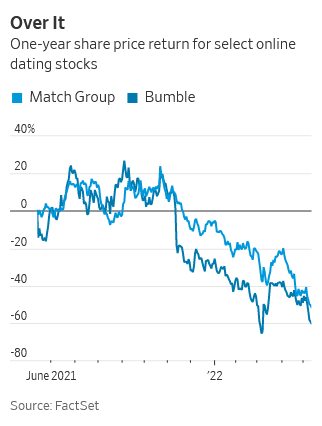
Investor Wariness of Subscription Tech Services Extended to Dating Apps
by Laura Forman
See full article at Wall Street Journal
See the top news on Match Group
See the top news on Bumble
See the top news on Pairs
Match Hopes Hinge Can Be Its Knight in Shining Armor
 WALL STREET JOURNAL – Match Group reported mixed Q4 results on Tuesday with adjusted operating income coming in just above Wall Street's estimate, while both Tinder revenue and total revenue growth fell slightly short of analysts' expectations. Match attributed the revenue shortfall to foreign exchange and lingering effects of Omicron. Match talked more about relationship app Hinge. Match now says Hinge did just under $200M in revenue last year and forecasts that revenue would grow to ~$300M this year. Hinge's payers increased ~60% in the Q4 quarter versus the same period of 2019 with revenue per payer growing ~300% over that period.
Match.com Brings Back the Human Touch
 WALL STREET JOURNAL – From online dating to social media, algorithms are getting more assistance from humans. Since February, Match Group has been testing a human matchmaking layer to its namesake Match app and will provide two handpicked matches for users willing to pay $4.99 a week. The pilot involves a 50-member team who have been trained as dating coaches by the company. Match said ~30% of its members have already opted in for the feature. Users of the feature were eight times more likely to match – or mutually like one another – with an expert pick versus without the service, Match said.
Match Group’s Shares Down 17%
 WALL STREET JOURNAL – Investors are dumping Match amid ongoing litigation risk. Match's shares are down ~17% since the trial began in November. Investors are overestimating the risks. A litigation analyst for Bloomberg Intelligence recently predicted Match has a 75% chance of winning the case. A 2017 report from Barclays showed Tinder did $176M in revenue in 2016 and, as of the Q1 of 2017, had less than a fifth of the payers it has today. No one predicted how much money Tinder Gold would make. According to Barclays Tinder's management predicted $454M in revenue in 2018 and Rad $503M. Barclays landed in the middle at $485M, significantly below the $800M the app actually ended up generating that year. Rad predicted 2020 revenue to be $892M. Last year, the app made $1.4B for Match. The banks ultimately valued Tinder at $3B in 2017, while the plaintiffs argue it should have been worth $13B.The case is set to go to a jury in early December. For Match, the worst case scenario seems unlikely. The judge has already said valuations of dating companies today can't be taken into account.
by Laura Forman
See full article at Wall Street Journal
Mark Brooks: Match Group didn't just buy Tinder. They bought Singlesnet, and OKCupid, and People Media, not to mention POF, to hit the home run with Tinder. Sam Yagan, Mandy Ginsberg, Amarnath Thombre and Shar Dubey, executed beautifully to allow Tinder to disrupt the market. (Full Disclosure: POF is a former client of Courtland Brooks, and I own Match Group stock)
Bumble Investors Should Be More Thankful
 WALL STREET JOURNAL – Bumble may never have the broad appeal of Match Group but it is looking more lovable. Since going public in February, its share price has dropped 54% from where it opened on its first day of trading. Over just the last three months, it is down 36%, while Match’s share price has fallen less than 2%. But according to Q3, Bumble ARPU was ~$23, growing 18.5% YOY. Bumble's worldwide download grew 20% YOY. Bumble reported Q3 revenue for its namesake app grew 39% YOY, suggesting more people who are downloading the app are opting to pay for it.
Investors See Big Potential in Smaller Online Dating Companies
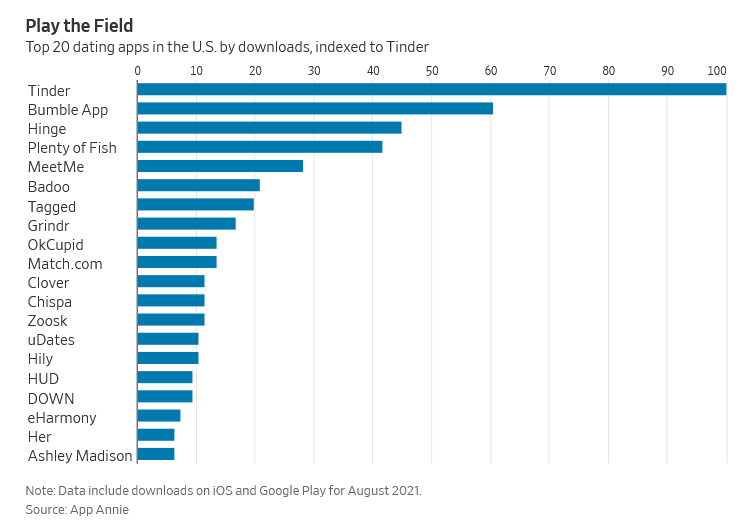
Bumble and Match Have Love Left to Give
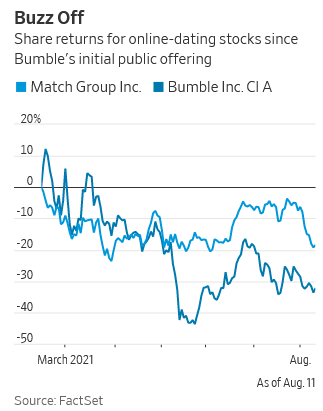
Dating-App Investors Should Play the Field

by Laura Forman
See full article at Wall Street Journal
See the top news on Match Group
See the top news on Tinder
See the top news on Bumble