PR NEWSWIRE – Feb 9 – DateShield is a new app that uses questions developed with psychologists to help women assess if a date might not be as sweet as he seems. The app alerts women to red flags when dating. The DateShield app guides users through a multi-step process that includes: answering questions about their dates, journaling impressions of their dates, acting on to-do-list items and reminders to learn more about their dates, being alerted when disturbing characteristics are revealed. After each assessment, the app adjusts a date rating dial based on the user's answers.
Month: February 2021
Facebook Sued for Copying Feature of Dating Among Friends
 PUNEKAR NEWS – Feb 8 – MTJF (More Than Just Friends), a mobile dating app that facilitates dating among friends, is suing Facebook for allegedly copying their unique feature of dating among friends. MTJF's unique feature helps users to secretly find out if their friends are interested in pursuing romantic relationships with them. Sangram Kakad, founder of MTJF reached out to Facebook to commercially exploit the idea. "However, Facebook did not revert and went ahead straight to copy and launch the unique feature of MTJF in Facebook calling it as 'Secret Crush', without any due credits to MTJF. Facebook, however, did not realize that Kakad has already filed an International Patent for this feature", Kakad said.
Interview With David Stephen Hyatt, Founder & CEO of Luxmada
 OPW INTERVIEW – Feb 17 – Luxmada has developed a new matching algorithm for online dating sites that predicts cohabitation compatibility which is an essential component of long-term relationship stability. It is called the Cohabitation Index. Here is our interview with Luxmada Founder & CEO, David Stephen Hyatt.
Can you tell us about the science behind your cohabitation test?
In a nutshell, the Cohabitation Index (CI) is a completely new, patent-pending algorithm that utilizes, among other things, asymmetric probability modeling to predict shared-space (i.e., domestic) compatibility. We use carefully crafted questions developed from peer-reviewed literature on (romantic) dyad matching and a robust mathematical design that moves beyond the fuzzy imprecision of current metrics (e.g., Likert scales, personality tests, etc.). The CI algorithm essentially measures the amount of predicted volatility with respect to the domestic space, and that's an incredibly important idea because relationships inevitably succeed or fail based on how well couples can navigate their shared-space landscape. Dating is only the first (and easiest) hurdle if you're even remotely interested in anything beyond hook-up culture.
Why is cohabitation so important compared to other compatibility aspects?
Great question. There exist two principal reasons. First, as we discuss in our report, recent academic studies suggest coeval matching algorithms are statistically insignificant and do a poor job of quantifying the kind of compatibility that leads to long-term relationship success. Unfortunately, these (dis)similarity measures are the only game in town with respect to curated matching, so they're not going away any time soon. The CI algorithm, which we assume will be used alongside the panoply of current (if flawed) matching techniques, focuses on those critical variables that academics suggest do portend relationship stability, giving users greater control over, and confidence in, their dating choices.
Second, cohabitation in the U.S. – to take one sizable market – has increased 900% since 1970, yet only 30% of cohabiting couples survive marriage. In fact, reported incompatibility has become a significant reason for relationship dissolution. This evinces the chasm between modern matching algorithms and the needs of online users who seek a long-term, meaningful relationship. Cohabitation compatibility, as an ineluctable component of a successful relationship, simply isn't being addressed by the online-dating industry; meanwhile, users invest time, money, and energy into relationships that could be doomed from the beginning. The CI algorithm measures that circumscribed aspect of relationship risk.
How do you see this integrating into a dating app?
There is nothing to suggest app integration would be a problem. Backend implementation across all modalities is seamless and nearly identical to current approaches. Users answer specific questions as they build their profile, and those responses are then used to construct a unique, precise, and asymmetrical "CI score" against any other profile in the database, a metric that even permits filtered searches based on any desired compatibility threshold. We also establish subcategory metrics so users can locate the locus of conflict and begin a targeted dialogue with potential matches about their domestic expectations. We believe the process of identifying potentially suboptimal matches by quantifying the likelihood of domestic conflict in inchoate relationships is as valuable as any matching strategy in use today – perhaps even more so considering what's at stake.
Why should companies use Luxmada's services rather than just go it alone and design their own test?
The short answer is convenience. We've already done the heavy lifting for you. We've examined the relevant literature, developed the mathematical framework, and performed robust statistical tests to measure the CI's predictive power against stochastic responses. See our report for details
The long answer comes in three parts. First, we have zero interest in market entry. Luxmada is an international think tank, which means we're not a dating site and we don't offer services of any kind. We developed the Cohabitation Index as a pragmatic response to a vital industry need, and we're advertising our IP for sale (or licensing) to interested parties. Think of us as intellectual facilitators rather than competitors. Second, it would be very difficult to reverse-engineer the CI infrastructure based solely on the prompts. The algorithmic magic resides in our specific mathematical design, and, as we all know, not every model generates meaningful data – even if the math works. Third, but certainly not least, our patent would likely create legal complications for foreign companies with a digital footprint in the States – while providing a complete barrier to development for American companies – but we've also engaged Oyen Wiggs, a prominent IP firm based in Vancouver, concerning PCT filing, which means there isn't much wiggle room for those who might wish to chart their own trajectories.
Do you have plans to offer more compatibility profiling?
The power and flexibility of the CI algorithm permit a range of interesting applications – from business management and team building to applicant profiling – and we're currently exploring those tangents, but, no, this is very likely our singular foray into the universe of online dating. At the moment, we're consumed with a number of high-profile projects, including cryptanalytic software and quantum-resistant authentication technology for primary-market consumer goods, but we hope we've convinced more than a few readers that cohabitation compatibility is an indispensable metric that must be addressed as the online-dating industry forges ahead. As we said when we began developing the CI algorithm: True compatibility doesn't begin until the honeymoon is over – an aphorism industry professionals should take seriously.
How Great Expectations Paved The Way for Tinder
 VOX – Feb 9 – Great Expectations, which existed into the '90s, was the original dating technology, and a national dating franchise. Members recorded a 3-minute conversation with questions like, "Do you work hard? What makes you angry? What are you looking for in a man/woman?" This was "video dating". People loved the richness of the medium. In the past 12 months modern dating apps have stumbled on that same thesis all over again. The earliest video-dating service was a year earlier than GE. A New York-based company called Videomate launched with the ad: "Now, you can see and hear your date on closed-circuit TV before you date. It's fun! It's riskless! It's new!" For $60, members received a 90-day membership. By 1986, GE customers were paying $625 for a six-month plan to $3,790 for a multi-year subscription. By the early 1990s, GE had 49 franchises and was earning $65m a year.
Bumble Aims for $8 Billion Value After IPO Boost
 BLOOMBERG – Feb 8 – Bumble is targeting to raise as much as $1.8B from its U.S. IPO after boosting the size of the deal. The company plans to sell 45M shares for $37 to $39 apiece. Bumble previously indicated it would look to sell 34.5M shares at $28 to $30. At the top of the new range, the IPO would value Bumble at ~$8B.
by Crystal Tse & Fareed Sahloul
See full article at Bloomberg
TrulyMadly’s Revenue Grew 4x in the Last 12 Months
 AFAQS – Feb 8 – TrulyMadly's CEO Snehil Khanor talks about the app's latest ad, competing against matrimony apps, arranged marriages, and Tier II and III users. "We are a serious dating app and the end goal of serious dating is marriage," remarked Snehil Khanor. Last week, the app released an ad called 'Worst Proposal Ever'. It is a parody of how families get involved when it comes to their kids' marriage. TrulyMadly claims to be in-between dating and matrimony apps. "The problem with matrimony apps is that they're similar to arranged marriages – parents meeting parents. Most profiles are operated by brother, mother, there is no freedom of choice. Our brand film is about freedom of choice," says Snehil Khanor. He also revealed that a big chunk of their engagement and revenue is coming from Tier II and Tier III cities. "Our overall revenue grew 4x in the last 12 months. The platform has 8M users as of now."
Google Ads to Prohibit Ads for Sugar Dating
 SEARCH ENGINE ROUNDTABLE – Feb 7 – Google will begin to prohibit what is called "sugar" dating, starting on February 11th, with full enforcement ramping up over 5 weeks. A warning will be issued, at least 7 days, prior to any suspension of your account.
by Barry Schwartz
See full article at Search Engine Roundtable
Blued Rolls out “Voice Chat Room” Function
 GLOBE NEWSWIRE – Feb 5 – Blued, a world-leading online LGBTQ platform, is launching a voice chat room function on its app in mainland China, allowing users to join chat rooms based on language, friends and interests.
Mandy Ginsberg: Year After Stepping Down as Match Group CEO
 DALLAS MORNING NEWS – Feb 8 – She's on the board of Uber Technologies and just joined the board of online thrift retailer thredUP. Her home in North Dallas was in the path of the October 2019 tornadoes. Then she discovered in January 2020 that her doctor had been trying for two months to reach her for a serious talk. That's when she decided to step down as CEO of Match Group. "I had to reevaluate," she said. The decision was easier because Match was performing well, she said, and she would be succeeded by a woman. Ginsberg said she was attracted to the thredUP board because it's mission-based. "I saw the passion for the business in [CEO] James Reinhart. If you can't help the world, why bother?" Secondhand can have a bigger place in the market, she said. It's an alternative to fast fashion, and it's not a new idea that "one person's trash is gold to someone else." Ginsberg is also on the board of Uber Technologies and said that being exposed to other companies that are disrupting markets and where "the sky's the limit is so much fun." She's not ruling out running a company again someday, and she believes it’s only a matter of time until women have parity in the C-suite.
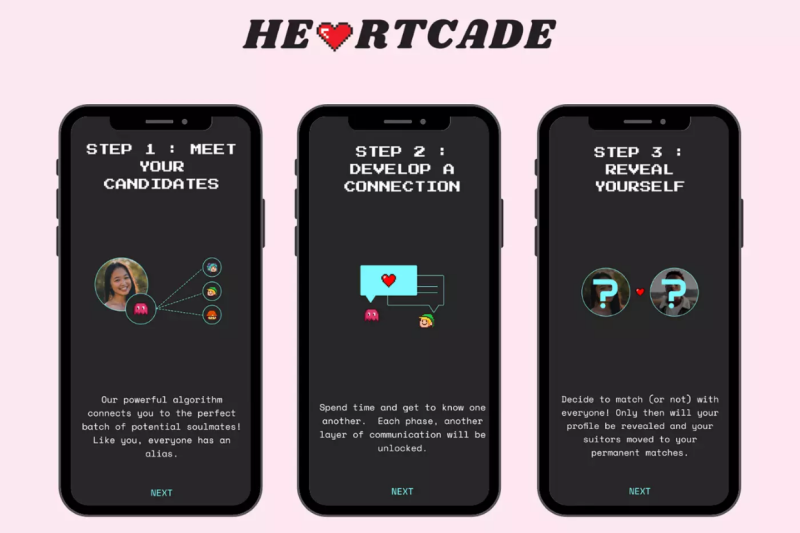
Heartcade Dating App That Won’t Let You See Your Match Before You Chat