NEW YORK TIMES – May 8 – Now that all American adults are eligible for vaccination and many of life's once-mundane routines are returning, dating has come back in force. Particularly for those singles who are vaccinated, the demand – or desire – to pair up is strong. In January, Three Day Rule, a matchmaking company operating in 12 cities, started to see a boom in business. "We've never been busier," said Talia Goldstein, its founder and president. In a recent report on the future of dating, Tinder said its users have become more truthful and transparent about personal boundaries. It also predicts that daters will continue to be more honest and authentic when the pandemic ends. Ms. Goldstein, of Three Day Rule, said many of her clients have become less superficial. In the past, their criteria often mentioned height or wealth. Now more people are prioritizing inner qualities, like humor or a "growth mind-set." And, with the flexibility of remote work, dating is not as localized as it once was.
Category: Outlets – New York Times
What It’s Like to Work With a Matchmaker
 NEW YORK TIMES – Feb 27 – Six customers of matchmaking services share their experiences. Their fees ranged from $500 to $25K. Many matchmakers either don't have or won't share statistics on their success rates. It's common not to provide references, citing a need to protect privacy. The companies generally aren't listed on review sites like Yelp. The New York Times interviewed a few singles across North America who have used matchmakers. Most of them agreed that the matches were better than Tinder matches. Here are edited versions of five conversations, including some comments and responses from the matchmakers.
Grindr Is Fined $11.7M Under European Privacy Law
 NEW YORK TIMES – Jan 26 – The Norwegian Data Protection Authority will fine Grindr $11.7M for illegally disclosing private details about its users to advertising companies. The agency said Grindr had transmitted users' precise locations, user-tracking codes and the app's name to at least five advertising companies, essentially tagging individuals as L.G.B.T.Q. without obtaining their explicit consent, in violation of European data protection law. Grindr shared users' private details with, among other companies, MoPub, Twitter's mobile advertising platform, which may in turn share data with ~100 partners. In a statement, a spokesperson for Grindr said the company had obtained "valid legal consent from all" of its users in Europe on multiple occasions and was confident that its "approach to user privacy is first in class" among social apps. The company has until Feb. 15 to comment on the ruling before it is final.
by Natasha Singer & Aaron Krolik
See full article at New York Times
Finding Love Without Alcohol
 NEW YORK TIMES – Dec 29 – According to a 2014 survey by Plenty of Fish, 48% of singles reported consuming two to three drinks on a first date and 36% percent have had a drink before a first date. Outside traditional dating apps, are online platforms like 12StepMatch, Love in Recovery and Single and Sober where it's understood that no one drinks. Loosid app, a sober social network that started in 2018, offers boozeless guides, chat groups and a sober dating platform.
by Hilary Sheinbaum
See full article at New York Times
See the top news on POF
See the top news on Loosid
See the top news on Single and Sober
Sparks Fly on Virtual Dates, but Not So Much in Real Life
 NEW YORK TIMES – Dec 8 – At the beginning of the pandemic, many singles turned to video dating. Some daters felt instant attraction online, but no chemistry in person. "Video gives us just one view of someone," said Dr. Jacqueline Mendez, a licensed marriage-family therapist and certified sex therapist in LA. "There's a missing piece of the energy of the physicality of the person. So what ends up happening is that we start developing a fantasy of this person, just given the information that we have." Another disadvantage of video dating is the inability to see a person's full body and gestures.
Apple Halves Its App Store Fee for Smaller Companies
 NEW YORK TIMES – Nov 19 – Apple, facing growing antitrust scrutiny over what it charges companies for access to its App Store, said it would cut in half the fee it takes from smaller app developers. Developers that brought in $1M or less from their apps in the previous year will pay a 15% commission on those app sales starting next year, down from 30%. The change will affect ~98% of the companies that pay Apple a commission, according to estimates from Sensor Tower, an app analytics firm. But those developers accounted for ~5% of App Store revenues last year. Apple said that it had made the change because 2020 was a difficult year for many small companies. The fee cut probably won't calm the waters between Apple and the larger app developers that have long protested the fee most loudly. Epic Games sued Apple in August. A month later, 13 companies, including Spotify and Match Group, formed the nonprofit Coalition for App Fairness to fight the "app tax." And American and European regulators are investigating Apple for anticompetitive behavior, partly because of its commission.

Dating in the Runup to the Election
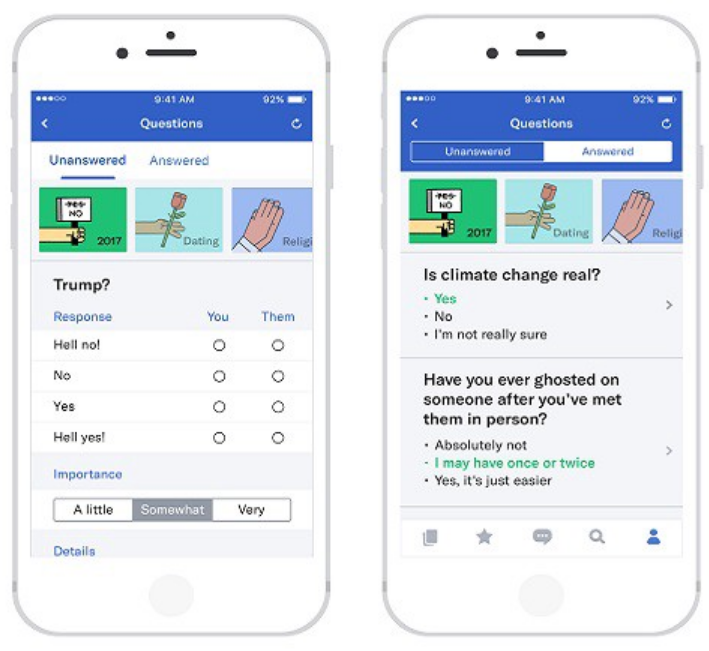
More Singles Are Fast Tracking New Relationships
 NEW YORK TIMES – Oct 8 – Americans are dating with an intention that some experts say that they haven't seen before. Many experts, along with daters themselves, say that daters have become more likely to couple up, to lower their standards and to do what they can to find a partner to face whatever comes next. Hinge's surveys indicate that 69% of the app's users are "thinking more about who they're really looking for" and 50% say they are "no longer chasing after people who aren't interested in them." A survey of 2K dating app users Match conducted between July and August, showed that 59% of daters were considering a wider range of people as potential partners and that 55% were fast tracking new relationships more than before the pandemic.
by Jonah Engel Bromwich & Sandra E. Garcia
See full article at New York Times
80% of Matchmakers Now Offer Coaching

How Coronavirus Is Changing the Dating Game for the Better