
 WALL STREET JOURNAL – Dating apps are asking users to pay more for features and access to matches as a way to counter slowing growth. WSJ's Heard on the Street columnist Laura Forman talks about the pressure on Match Group.
Category: Outlets – Wall Street Journal
Speed Dating Is Back
 WALL STREET JOURNAL – Daters with swipe fatigue are signing up for singles' nights and speed-meeting events. Attendance at speed-dating events put on by Pre-Dating Speed Dating waned as dating apps took off in the early part of the last decade, says Linda deLucca, the company's co-owner. Many of its competitors shut down. In the past year, however, Ms. deLucca says demand is higher than when the company started in 2001. Pre-Dating operates across 70 cities in the U.S. MyCheekyDate runs speed dating for gay and straight singles in 50 cities in the U.S. and another dozen around the world.
Being a Cheap Date Now an Attractive Quality

Grindr Plans to Focus on Monetization After IPO
 WALL STREET JOURNAL – Grindr is set to list on the New York Stock Exchange today, and the company plans to further monetize its services, review subscription prices and beef up its finance team once it joins the public markets via a merger with a special-purpose acquisition company. Grindr will combine with blank-check company Tiga Acquisition. The transaction, valued at $2.1B, is expected to provide Grindr with ~$384M in proceeds, which will bolster its balance sheet and help with paying down debt. The company will list on the New York Stock Exchange under a new name, Grindr Inc. During Q2, Grindr's revenue grew 34% YOY, to $46.6M. The company reported a net income loss of $4.3M in Q2 compared with a $1.8M profit in Q2 '21. The year-over-year loss was largely driven by one-time costs associated with going public, such as legal, consulting and audit fees. Q3 results haven't been released yet.
by Jennifer Williams-Alvarez
See full article at Wall Street Journal
Single People Want Deeper Connections and More Substance
 WALL STREET JOURNAL – Singles are emerging from the pandemic more serious about finding a partner and less focused on looks, according to the latest Singles in America study, conducted by researchers at the Kinsey Institute and funded by Match. ~75% of the study's participants say they want to find a partner who wants to marry, roughly similar to last year and up from 58% in 2019. Singles became more interested in finding a stable partner and they're spending more time on phone calls and video chats before meeting IRL. Today, one-quarter of singles say they've had a video chat with a date before meeting in person, up from 6% in 2019. Each year, researchers ask single people what they’re looking for in a partner. The No. 1 answer this year is "someone to trust and confide in." Physical attraction dropped out of the top five during the pandemic.
by Elizabeth Bernstein
See full article at Wall Street Journal
Dating Apps Test the Price of Love
 WALL STREET JOURNAL – A decade into the dating-app era, many apps have switched from free to "freemium" models, offering paid subscriptions and a la carte features that are meant to improve the odds of finding a match. The most popular dating apps all offer paid memberships that can run from $12 a month to $600 a year. Dating app executives say that while paying isn't necessary to find a match, paid features can help users save time and find connections more easily. The free version of Hinge has a limit on the number of likes each user can send and displays blurred photos. The paid version offers users unlimited likes and clearly displays the profiles of users who like them. Another common add-on is a "boost," where a user's profile is shown to more people in a set period. Tinder has 10.9M paid users to date and is currently at work on a new paid feature, says Faye Iosotaluno, the company's COO.
How Online Dating Scams Work – and Who Gets Targeted
 WALL STREET JOURNAL – Americans reported losing ~$1.3B in romance-related fraud from 2017 to 2021, according to the FTC, greater than any other category of fraud tracked by the agency. Scammers typically target older, poorer, less educated and single people. Women are reported to lose more significant sums of money. In the majority of cases, the victims are older than 40, with 50 to 59 being the most vulnerable. Data also suggest that the degree of financial loss increases with the age of the victim. Dating sites should have built-in technical trust-building mechanisms. Simple two-factor authentication can substantially reduce the number of fake accounts by weeding out less-sophisticated scammers. The industry also needs to develop a web-assurance seal program – an outside agency that monitors and ensures that sites comply with the policies.
Online Dating Is Great for Investors, Complicated for Customers
 WALL STREET JOURNAL – Together, Wall Street expects Match and Bumble to generate ~$4B this year. Online dating provides more specific results from a wider net. Tinder has ~10M people paying to meet someone on the app. But pitfalls abound. People use dating apps because everyone else seems to be using them. A recent study by the Marriage Foundation found couples who met online were six times more likely to get divorced in the first three years of their marriage than those who met in college or through family or friends. Romantic love may need to adapt to technology rather than the other way around.
by Laura Forman
See full article at Wall Street Journal
See the top news on Match Group
See the top news on Bumble
See the top news on Tinder
Investor Wariness of Subscription Tech Services Extended to Dating Apps
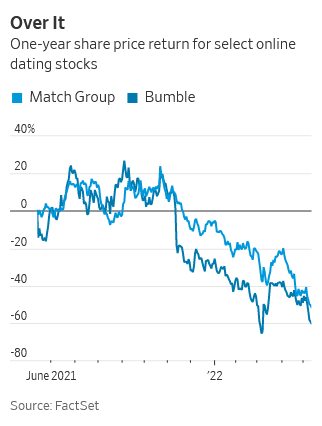
by Laura Forman
See full article at Wall Street Journal
See the top news on Match Group
See the top news on Bumble
See the top news on Pairs
Grindr User Data Has Been for Sale for Years
 WALL STREET JOURNAL – Grindr's user locations were collected and sold via ad networks since at least 2017; Grindr says it has curtailed the data it shares. Grindr cut off the flow of location data to any ad networks, ending the possibility of such data collection two years ago, the company said. The data didn't contain personal information such as names or phone numbers. But the Grindr data were in some cases detailed enough to infer things like romantic encounters between specific users, as well as identify clues to people's identities such as their workplaces and home addresses. "Since early 2020, Grindr has shared less information with ad partners than any of the big tech platforms and most of our competitors," a spokesman for Grindr said in a statement.
by Byron Tau & Georgia Wells
See full article at Wall Street Journal