WALL STREET JOURNAL – June 10 – "It's giving us a chance to rethink the way we date and meet people," said Dani Fankhauser, who co-founded XO, a new app that aims to facilitate meaningful and more playful relationships. XO uses in-app icebreakers games like "Kiss, Marry, Fight" (choose which of three celebrities/cartoons/brand mascots you want to Kiss, Marry or Fight). This week Coffee Meets Bagel is rolling out a "Virtual Date Nudge" to facilitate socially distanced relationships. Once two people have swiped and started chatting, the app prompts each one to select a digital-date idea from a list of six, including a game night, a virtual museum tour or the swapping of recipes to cook together over video. When one person selects one, signaling "I'm open to it," the other is alerted.
Category: Outlets – Wall Street Journal
U.S. Approves Sale of Grindr
 WALL STREET JOURNAL – May 30 – U.S. national security officials have approved an investor group's purchase of gay-dating app Grindr that is being sold by a Chinese company after the Trump administration raised concerns about the potential theft of Americans' personal data. China's Beijing Kunlun Tech said that the buyer – San Vicente Acquisition – has secured approval from the Committee on Foreign Investment in the U.S. Grindr could be sold for $608.5M. In 2016, Kunlun paid $93M for a 60% stake in Grindr. It acquired the rest of Grindr for $152M in 2018.
Q&A With CEO of IAC About How Pandemic Affects Its Businesses
 WALL STREET JOURNAL – Apr 14 – From online dating to home-repair help, some of the biggest businesses in IAC's portfolio are built on in-person social interaction.
Q: Which IAC brands are hurting the most from the pandemic?
A: ANGI Homeservices works with 250K small businesses that have ~2M employees – painters, electricians, contractors. When they're not allowed to go into somebody's house, those businesses are hit. We've been trying to navigate the regulatory environment, the federal stimulus aid, to figure out how to make sure these small businesses get access to loans.
Q: How has the way you manage changed during the pandemic?
A: We never used to do a call or a meeting with all the CEOs of IAC companies. We would do a dinner once a quarter. But we now do a weekly CEO call, where everybody cares what the other businesses are doing. It helps them put their own experience in context because everyone's experiencing totally new ground and new trends.
Q: How has Match adjusted its online-dating business model to social distancing?
A: We're prioritizing video. We're now looking at all of our products to see how we can integrate video as quickly as possible. Video has been on our road map at Match several times in the last few years, and it never really stuck. People weren't as tolerant of the imperfections of video. Now it's becoming way more acceptable in dating.
Q: What sort of advice is Barry Diller giving you right now?
A: Barry is an optimist, and optimism is really important right now. He’s patient, and that's been an asset for IAC for a very long time. Being patient doesn't mean to miss a moment, but to understand what the current environment is. And the current environment is something that we'll get through, provided you're financially organized to do that.
Q: What's a big lesson you've learned from the pandemic?
A: You can do all the disaster planning in the world, but you can always be surprised. No matter how good things look, you've got to maintain the strength of the balance sheet and some flexibility. The strength of things like working capital matters a lot in moments like these.
As Match Breaks Away, Investors Shouldn’t Break Up
 WALL STREET JOURNAL – Apr 13 – Like many of its Internet peers, shares of Match Group fell precipitously through mid-March as investors feared users would abandon subscriptions in the face of lockdowns. In an investor update on March 31, Match noted results would likely be around the low end of ranges it previously shared. And while the company also said it could be challenging to boost revenue sequentially in the second quarter, it still expects to show YOY growth. Match said the length of conversations on Tinder is up anywhere from 10% to 30% in many countries. Tinder accounted for 56% of Match's revenue in 2019. Relationship-focused app Hinge has seen a 30% increase in messages in March compared with January and February. A recent survey from Jefferies highlighted growth opportunities across Match's portfolio. The survey showed that, while just 13% of dating-app users say they already pay for services that increase their chances of finding a match, 47% said they were likely to pay for those services in the future.
Coronavirus Makes Dating a Lot More Complicated
 WALL STREET JOURNAL – Mar 23 – Trying to build a relationship while reducing human contact during the coronavirus pandemic is tricky. New York City Mayor Bill de Blasio weighed in to give dating advice earlier this month. "If you're sick, don't go on a date. If the date is sick, don't go on the date," he said. As far as kissing at the end of a date, he called it "wise" to abstain. That was then. Now, much of the country has been ordered to stay inside their homes, and most Americans have cut off in-person contact. This leaves little room for romance. But human nature dictates: the longer people are isolated, the more they crave companionship. "People don't want to feel alone, and they've already watched everything on Netflix," said Adam Cohen-Aslatei, CEO of dating app S'More. The average number of daily users of S'More increased 28% the third week of March and the length of conversations has doubled. Say Allo saw a 350% increase in video-date sessions in the early weeks of March.
Match Group CEO Mandy Ginsberg Steps Down
 WALL STREET JOURNAL – Jan 28 – Match Group CEO Mandy Ginsberg (50) is stepping down. President Shar Dubey will be CEO starting March 1. Mandy served at Match Group for 14 years and was CEO since 2017. Match's stock quadrupled during her tenure.
"When I started in 2006, we were just launching the second brand at Match and only 3% of relationships were from dating apps (that number is a whopping 50% today in North America and Western Europe and growing every day across the globe!)."
In October, a tornado left her Dallas home unlivable, and she also has experienced what she called "health hiccups." She opted for a preventive double mastectomy due to high risk of breast cancer. The implants she received are linked to cancer, and so last Friday she underwent another surgery due to a recall of the implants. "I need to take care of myself and so will take some time off this year to do just that."
Co-Parenting Sites Skip Love and Marriage, Go Right to the Baby Carriage
 WALL STREET JOURNAL – Jan 7 – Sites like PollenTree.com and Modamily match people who want to have children, but not necessarily romance. "The alarm clock goes off for men as much as it does for women. You'd be surprised by the number of young, professional straight men who want to have kids," said Patrick Harrison, co-founder of PollenTree, the largest of the subscription-based co-parenting sites. (The service also connects people with egg and sperm donors.) He said ~60% of the co-parenting seekers are women. The male clientele is evenly split between single gay men and heterosexual men, both seeking to be co-parents with women. There are also same-sex couples looking to have a mother or father figure in their child's life. The success rate is hard to measure. PollenTree has had ~90K members since its 2012 launch. Mr. Harrison estimates that ~500 babies have been born as a result of co-parenting matches on the site.
Match Group Gets Boost From Wall Street Analysts
 WALL STREET JOURNAL – Nov 7 – Match Group offers attractive potential for growth, analysts say. Shares slid late Wednesday after its outlook for the current fiscal quarter left investors disappointed. But after a string of bullish analyst notes, the stock rebounded – finishing Thursday up 4%, compared with the S&P 500, which rose 0.3%. IAC which has an 81% stake in Match, climbed 3.8%. Competitors also took a leg higher: The Meet Group, which owns a live-streaming dating game called NextDate, added 9.4%.
Match Group Q3 Earnings, Shares Plummet Following a Weak Q4 Forecast
 WSJ – Nov 6 – In Q3, Match Group's profit rose to $151.5M, from $130M in Q3 '18. The revenue rose 22% YOY to $541.5M, topping analysts' expectations of $540.7M. Yet total operating costs and expenses jumped 20% in the quarter as selling and marketing, product development, amortization and general operating expenses nudged higher. Overall average subscribers rose to 9.6M in the latest quarter, up from 8.1M in the year-ago period. Shares of Match Group dropped 16% after the company's financial targets for the current quarter came in below analysts' estimates. Match Group said it expects total revenue for the Q4 to be $545M – $555M, falling below analysts' estimates of $559M in revenue. Match also projected adjusted EBITDA in the range of $205M to $210M, behind analysts'target of $228M, and also said it expects to spend ~$25M in long-term investments and incremental legal costs in the Q4. Match Group is involved in several legal tussles, most recently with the Federal Trade Commission over claims that it induced nonpaying users to subscribe to its Match.com app based on "fake profiles." Match is also involved in an intellectual-property battle with Bumble, as well as multiple suits against a Tinder co-founder.
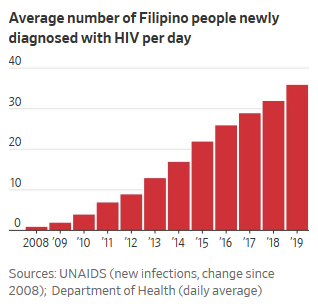
HIV Cases Soar in the Philippines, as Dating Apps Spread