
 PR NEWSWIRE – The Kaspersky report, "Digital Uncertainty: Scams, Privacy and Artificial Intelligence," reveals widespread encounters with scams across social media, dating apps, and other online platforms. Key findings show that 42% of users have encountered scams on dating apps and 38% on Facebook, with 29% falling victim to scams overall. The report highlights a 40% increase in phishing attacks in 2023 and a strong consumer call for new privacy regulations in 2024. Concerns also extend to the potential privacy and security impacts of AI, with 38% of respondents wary about its future role.
Category: All Internet Dating Statistics
2024 Dating Trends: Navigating Challenges and Changes in Modern Relationships
 FORBES – In 2024, dating trends continue to evolve. A Pew Research Center survey shows that while dating has become harder since the COVID-19 pandemic, the interest in finding a serious partner remains unchanged. People are now marrying later in life and facing mental health challenges related to online dating. Surveys indicate that older adults find significant success on dating apps, and there's a strong preference for emotional maturity over physical appearance in dating choices. Additionally, economic pressures have led to more budget-conscious dating behaviors. Overall, the complex relationship between dating apps and mental health, including issues like loneliness and psychological distress, highlights the evolving challenges and priorities in the modern dating landscape.
Speed Dating Is Making a Comeback
 USA TODAY – Speed dating is experiencing a resurgence among Gen Z and millennials, who are seeking alternatives to dating apps. Experts suggest that speed dating offers a more personal way to meet potential partners and is a great option for those looking for genuine connections. Eventbrite has reported significant increases in speed dating events and attendance in recent years. Despite this trend, dating apps continue to be a popular way for people to meet, with a 2023 Pew Research Center report indicating that one-in-ten partnered adults met their significant other online. However, there is a notable lack of enthusiasm for online dating among Gen Z, with only 26% of users between 18 and 29.
Gen Z Prefer Digital First Dates
 NEW YORK POST – A Wingman survey of 500 people aged 18 to 27 found that 65% of Gen Z prefer digital first dates, mainly for efficiency and cost-saving reasons. The trend, popularized during the pandemic, allows for quick compatibility checks and multiple dates without the expenses of dining out or transportation. However, it risks missing out on deeper, in-person connections.
The Cost of Dating in 2024 Is Stressing People out, Survey Finds
FOX5 – In 2024, a survey by Self Financial revealed that ~69% of American adults are uneasy about the cost of dating, with 68% anxious about managing expenses for a date. This aligns with a 2022 Lending Tree survey where one in five Americans avoided dating due to rising costs. Despite financial concerns, two-thirds of respondents believe spending more on a date increases its success. On average, men spend $67.87, while women spend $56.61 per date, with dinner being the preferred choice. A 2020 Lending Tree survey showed that Gen Z spends $72, Millennials $83, Gen X $82, and Baby Boomers $58 on a first date.


Dating App Downloads Are Slowing Down
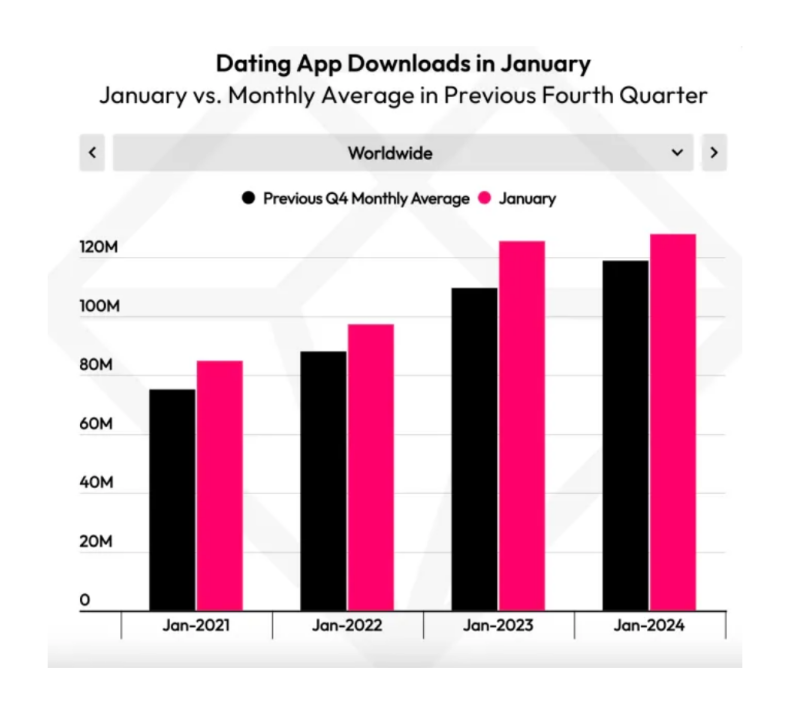
Kaspersky: Digital Stalking Affects a Quarter of Online Daters
 BACKEND NEWS – According to the latest study by Kaspersky, a cybersecurity solutions provider, digital stalking remains a significant concern for individuals engaging in online dating. The study, which surveyed 1K people across 21 countries, found that 23% of respondents reported experiencing some form of online stalking from someone they had recently started dating online. Females reported experiencing abuse at a higher rate (42%) compared to male respondents (36%).
Speed Dating Is Making a Comeback

State of Mobile 2024
 DATA.AI – In the mobile-centric world of 2023, app usage has hit a record high, with the average time spent on mobile in the top 10 markets exceeding 5 hours, a 2% increase from the previous year. Despite a 2% decline in global consumer spending in 2022, it rebounded with a 4% growth in 2023. The State of Mobile 2024 report offers insights into market trends, industry developments, and best practices across 11 industries and 30 markets. The report highlights high-growth sectors, the impact of AI on mobile, top apps and games, and global app usage trends.
Online Dating Scams Peak Ahead of Valentine’s Day
 CBS NEWS – The period leading up to Valentine's Day sees a spike in online dating scams, with a significant increase in the use of bots and AI by scammers. According to Arkose Labs, dating apps experienced a 2087% rise in bot attacks from January 2023 to January 2024. These bots create fake profiles to initiate relationships and eventually convince victims to send money. In 2022, romance scams affected 70K people, resulting in $1.3B in reported losses, predominantly targeting individuals aged 51 to 60. Warning signs of potential scams include overly formal messages, inconsistent information, odd communication patterns, unrealistic photos, and requests for money.
by Ash-har Quraishi & Amy Corral
See full article at CBS News